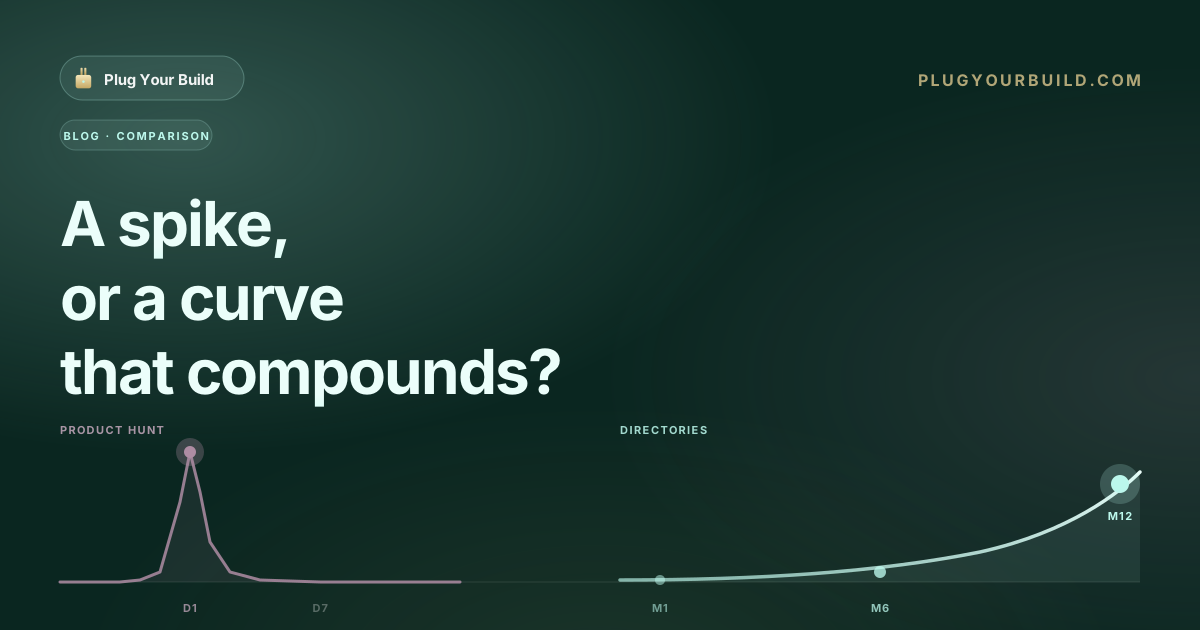
The Product-Hunt-versus-directories debate is usually framed as either-or. It shouldn't be. They're not the same kind of channel, they don't run on the same clock, and the question "which drives more long-term traffic" has a clear answer only when "long-term" is defined.
Twelve months out, directories drive more. Twenty-four hours after launch, Product Hunt drives more. Both numbers are true. The question is which one matters for your product.
The shape of Product Hunt traffic
A successful Product Hunt launch follows a predictable curve. The submission goes live at midnight Pacific. Engagement climbs through the morning. The peak hits between 9 and 11 a.m. Pacific. Traffic decays through the afternoon. By the next day, the launch is buried under newer submissions.
A top-three launch for an indie product typically drives between 2,000 and 5,000 visitors in the first twenty-four hours, with another 500 to 1,500 over the following two days. After the third day, the trickle drops to single-digit daily visitors from the Product Hunt page itself.
That's the spike. It's real, it's significant, and it stops.
The launch can produce second-order effects: press coverage if the product was novel enough, follows on social if the founder engaged actively, and a small Indie Hackers or HN ripple if the launch got noticed by adjacent communities. These second-order effects are unpredictable. Most launches don't produce them.
The shape of directory traffic
A quality directory listing produces a small daily flow that doesn't stop.
A well-placed listing on a directory with 10,000 monthly visitors at a 1.5 to 2.5 percent click-through rate sends 150 to 250 visitors per month. That's six to nine per day. Boring. But every day, indefinitely.
A cluster of five quality listings produces 30 to 60 visitors per day. Most of those visitors are in active evaluation mode because directory browsers search before they click. The conversion rate from directory traffic to signup is typically two to four times higher than from social referrals.
The traffic from one directory listing in month one looks identical to the traffic from the same listing in month twelve. The only thing that changes is the total accumulated over time.
The math at twelve months
A best-case Product Hunt launch drives roughly 5,000 visitors in the first three days and another 200 over the following twelve months as long-tail referral traffic. Total: 5,200 visitors over twelve months from one launch.
Five quality directory listings, maintained, drive a combined 30 to 60 visitors per day. Over twelve months that's 11,000 to 22,000 visitors. Conservatively: 14,000 over twelve months from a cluster of directories.
The directory cluster wins by 2.5 to 4x at the twelve-month mark on absolute traffic. The advantage compounds further at month eighteen and month twenty-four because the directory cluster keeps producing while the Product Hunt long tail decays to near zero.
For traffic alone, this is the comparison. Directories deliver more total volume over any horizon longer than three to four weeks.
When Product Hunt wins anyway
Total traffic isn't always what matters. Product Hunt has advantages directories don't.
The spike itself is a forcing function. The 5,000 visitors in 24 hours expose a product to a higher load than any directory will. Bugs surface. Onboarding flows break. The launch tells you whether the product can handle attention, in a way slow accumulation can't.
Social proof. A successful Product Hunt placement becomes a permanent badge for the product. "Featured on Product Hunt" or a top-three finish carries weight in press coverage, investor conversations, and downstream marketing for years.
Press and influencer pickup. Journalists and creators monitor Product Hunt for stories. A launch that lands in the top three has a non-trivial chance of producing a TechCrunch mention or a creator video. Directories don't produce these.
Community engagement. The Product Hunt comment thread, when it lands well, is where the most direct feedback the product will ever receive lives. Users describe exactly what works and what doesn't. That feedback is worth more than the traffic itself for a pre-product-market-fit product.
When directories win
Most of the time, especially for makers who already have a working product and just need durable traffic, directories win.
The work-to-result ratio. A Product Hunt launch is a multi-day full-attention project: asset prep, scheduling, comment engagement, follow-up. A directory listing is thirty minutes of submission work. The compounding traffic per unit of effort is dramatically higher for directories.
Predictability. Directory traffic shows up steadily. Product Hunt traffic is binary: a top-three placement is enormous, but a placement outside the top ten is almost nothing. Most launches end up outside the top ten.
Repeatability. A maker can only launch on Product Hunt once per product (occasional "v2" relaunches aside). Directory submissions can be ten or twenty placements, each compounding independently.
SEO benefit. Directory listings are backlinks from topically relevant, frequently crawled domains. Five quality directory backlinks meaningfully accelerate organic search rankings for a new product. A Product Hunt link is one backlink, and Product Hunt's backlink value is heavily weighted toward top placements.
The actual answer
Run both. Sequence matters.
Submit to two or three quality directories before the Product Hunt launch. Not because the directory traffic is what the launch needs, but because directory listings produce backlinks that improve the product's own domain authority before the launch, which makes the Product Hunt traffic convert better.
Run the Product Hunt launch when the product is ready for sustained attention and the assets are polished. Use the launch as the punctuation, not the strategy.
After the launch settles (usually one to two weeks), submit to the remaining ten to fifteen quality directories over the following six weeks. This converts the Product Hunt spike into a permanent baseline.
The result: a Product Hunt launch that produces 5,200 visitors over twelve months, plus a directory cluster that produces 14,000 visitors over the same twelve months. Combined: 19,200 visitors. Most of the value comes from the directories. Almost all of the perception value (the badge, the press, the validation) comes from Product Hunt.
The two channels do different jobs. Treating them as substitutes is the mistake. Treating Product Hunt as the launch and directories as the foundation is the model that actually works.
Plug Your Build is a permanent directory for indie makers across SaaS, newsletters, courses, Gumroad assets, Discord servers, and more. Standard listings start at $3.99/month and stay live indefinitely. Submit yours here.