Most SaaS pricing advice is written for VC-backed companies optimizing for $50k+ annual contracts. For a solo founder pricing a tool that solves a specific problem for indie makers, freelancers, or small teams, that advice mostly doesn't apply. The math is different, the audience is different, and the optimization target is different.
The version of pricing that works for solo SaaS is narrower, faster, and more iterative. Three inputs, one framework, one re-pricing cadence.
The three inputs
Three pieces of information determine the starting price for almost any solo SaaS product.
Cost floor. The minimum price below which serving each user costs more than the revenue from that user. For most indie SaaS products, this is somewhere between $2 and $8 per user per month, dominated by infrastructure (Postgres, Stripe fees, file storage, AI API calls if relevant) plus a small allocation for support. If the cost floor is unknown, calculate it before pricing.
Competitor anchor. What three to five direct competitors charge for the equivalent tier. Direct competitors, not adjacent categories. The competitor anchor sets the rough range the market expects to see; pricing 5x above the anchor needs a strong reason, and pricing 5x below the anchor signals "this isn't a serious product" more than it signals value.
Value capture estimate. The dollar value a typical user gets from the product, expressed conservatively. A solo SaaS that saves a freelancer two hours per week is worth roughly 2 × 4 × $50 (assuming a $50/hour billing rate) = $400/month in value captured. Charging $19/month captures roughly 5 percent of that value, which is the typical solo SaaS range (3 to 10 percent of value captured).
Three inputs, one decision. The price sits somewhere in the intersection of all three.
The framework
Pick the highest of the three:
- Cost floor times two (minimum viable margin).
- Lower bound of the competitor anchor range.
- Five percent of estimated value captured.
That's the starting price. It's deliberately conservative. Solo founders consistently underprice and rarely overprice, so erring high is the safer mistake.
For most indie SaaS products targeting other indie makers or small businesses, this calculation lands somewhere between $9 and $49 per user per month. Higher than that requires either substantial value capture (the product saves users a lot of money) or significant differentiation from cheaper alternatives.
Free trial versus freemium
The decision matters more than most pricing advice suggests, and the right answer is usually free trial, not freemium.
Free trial works when activation is fast, the value is obvious within minutes, and the cost of supporting a non-converting user is low. Most indie SaaS fits this profile. A 14-day or 30-day free trial without a credit card requirement, followed by a forced upgrade or downgrade prompt, converts at typically 8 to 15 percent for products that hit activation.
Freemium works when the free tier creates network effects (other users benefit from each free user being on the platform), or when the free tier is so limited that paid is the obvious upgrade for any serious use. Most indie SaaS doesn't have network effects, and most indie SaaS founders set the free tier too generously, which kills conversion. Freemium becomes a permanent free product.
The default recommendation: start with a 14-day free trial, no credit card. Move to freemium only if data later shows the free trial conversion is failing for retention reasons rather than evaluation reasons.
Annual versus monthly
Two prices, two purposes.
Monthly. Lower commitment. Higher churn. Targets users in evaluation or short-term need. The default for early-stage products.
Annual. Lower per-month price (typically 15 to 20 percent discount). Higher commitment. Better cash flow. Targets users with established usage who want to lock in.
The mistake most solo founders make: launching with annual-only or monthly-only. The honest version is both, with annual at a 17 to 20 percent discount over monthly. The annual option self-selects the most committed customers and dramatically improves cash flow even at modest annual mix (15 to 30 percent of paid customers tend to choose annual).
Annual revenue is also easier to forecast, which matters for solo founders making decisions about whether to keep building.
Pricing tiers
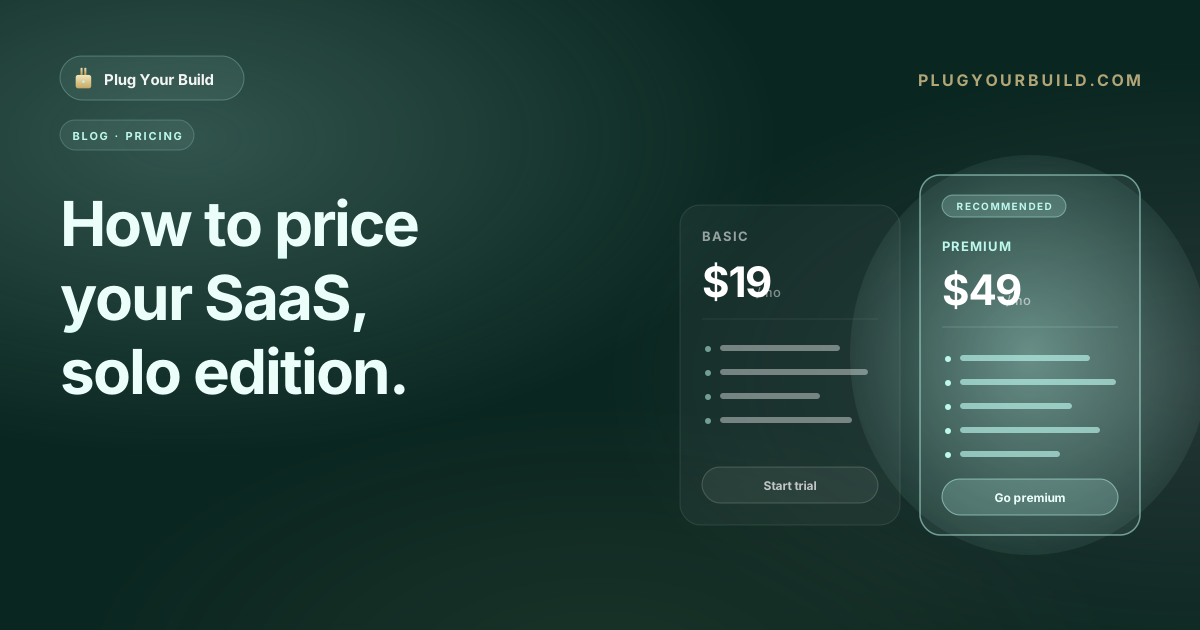
Two tiers (a basic and a premium) is the sweet spot for most solo SaaS. Three tiers (basic, premium, team) start working at the point where team plans make sense, typically 100+ paid customers.
The structural rule: tiers should be priced 2x to 4x apart, not 1.5x apart. A $19 / $29 / $49 structure produces confusion and low premium adoption. A $19 / $49 / $99 structure produces clear differentiation and predictable tier distribution (typically 60/30/10 across basic, premium, team).
The features that go in the premium tier are not always "more of the same thing." Better differentiators: collaboration features, advanced analytics, API access, removed limits on the resource the user cares about most, priority support. Pricing for these differentiators is more about the buyer's willingness to pay for "the serious version" than about the marginal cost of providing them.
When to raise prices
The recompute trigger for raising prices is two specific signals appearing together.
Signal one: at least 70 percent of new customers convert without price-related objections in onboarding or sales conversations. This indicates the current price is below the perceived value.
Signal two: at least three months of retention data shows healthy renewal rates (above 90 percent for monthly plans, above 80 percent for annual). This indicates the product delivers enough value that customers don't leave, which means the price wasn't excluding the right segment.
When both signals appear, raise prices 15 to 25 percent on new customers. Grandfather existing customers at their current price (this is both better PR and operationally simpler). Monitor for two to three months. If the conversion rate doesn't drop more than 10 to 15 percent, the price was too low. If it drops more than that, back off slightly.
A 20 percent annual price increase on a SaaS doing $5k monthly is $12k of new annual revenue with no additional acquisition cost. Most solo founders skip this lever for years because raising prices feels confrontational. It isn't; it's data.
The anti-patterns
Three pricing mistakes recur often enough to call out specifically.
Pricing on hope. Setting a price low because "I just want users first." This sets a low ceiling that's painful to raise later, and the low-paying users typically have the highest support burden per dollar. Charge a real price from day one.
Pricing on competitor parity to the dollar. Matching a competitor's $29 with another $29. The market doesn't reward matching; it rewards differentiation. A $24 or $34 price point produces clearer positioning than $29.
Discount stacking. Annual discount plus launch discount plus referral discount plus newsletter signup discount stacks into a 60 percent effective discount. The customer paid $13 for a $29 product, and the price they remember anchors their willingness to renew. Run one discount at a time.
The simple version
Pick the highest of: cost floor times two, the low end of competitor pricing, or 5 percent of estimated value captured. Default to a 14-day free trial without a credit card. Offer monthly and annual, with annual at a 17 to 20 percent discount. Use two tiers priced 2.5 to 4x apart. Revisit pricing every 6 months.
Most solo SaaS prices that follow this framework land in the right range on the first try. The ones that don't, the framework also tells you when to fix.
Plug Your Build is a permanent directory for indie makers across SaaS, newsletters, courses, Gumroad assets, Discord servers, and more. Standard listings start at $3.99/month and stay live indefinitely. Submit yours here.